


search
date/time

Sat, 1:00PM
light rain
8.7°C
SSE 23mph
light rain
8.7°C
SSE 23mph
 | Sunrise | 6:55AM |
| Sunset | 4:54PM |  |

Steve Whitaker
Features Writer
@stevewhitaker1.bsky.social
P.ublished 3rd October 2026
arts
Review: Peas On Your Knees - A Life In The Poems Of Michael Rosen
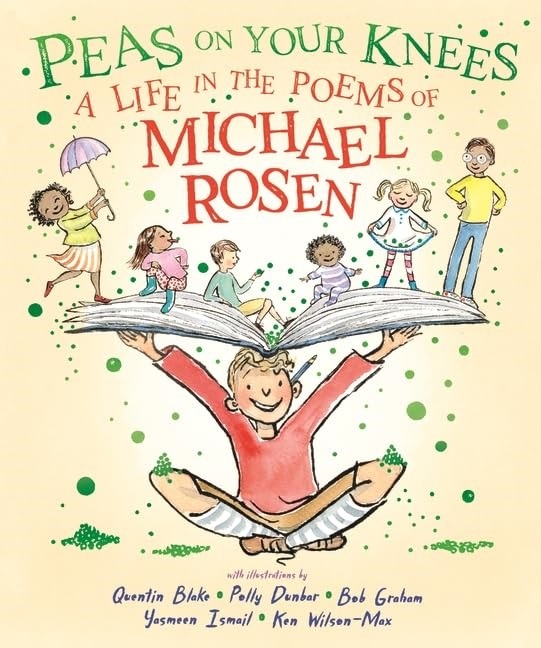
This poet, some might say entertainer, is at his most generous in delicious precis: Walker Books’ new selection of some of the very best of his poetry for children is a fine anthology in the round, yielding, as the title might suggest, a window on the creative imagination of the author. Peas on Your Knees: A Life in the Poems of Michael Rosen is an outstanding and incisive resume of the poet’s work, fully warranting its fizzingly refulgent kaleidoscope of illustrations, conceived, almost as an homage, by some seriously renowned artists, including Quentin Blake, Polly Dunbar, Bob Graham, Yasmeen Ismail and Ken Wilson-Max.
What appears to mark Rosen out as unique, aside from his marvellously diverting performative instinct, is his ability to locate situational authenticity in his portrayal of the complex relationship between adults and children. Imagined from the perspective of a child, most often as a simulacrum of himself as child, Rosen reinvents touchstones and points of friction vicariously as he inhabits the juvenile mind with acrobatic acuity. More often still, the satirical ‘victim’ of the piece will be the parent. The simple, deliberately foreshortened lines of ‘Hot Food’ underline the importance of blowing on a hot potato prior to consuming a forkful, before setting up a lovely counterpoint as the father figure almost chokes on a scorching lump. The humour, and Rosen is always very funny in a behind-the-hand chortly kind of way, consists in the father’s chastened harrumph:
‘”Watch out, everybody -
the potato’s very hot.”’
Parental vision is frequently obscured by exercises in wool-pulling, as though real nuggets of wisdom were vouchsafed only to kids; what, after all, do mums and dads know? Rosen’s capacity to be partisan consists in a conspiratorial sense of complicity – he understands, with uncanny insight, the simple motors of Pavlovian desire, especially as they relate to the urge to guzzle, at liberty and to excess. His gleeful immersion in the pantomime exchange of childish demand and parental denial is one measure of the poet’s obvious identification, and it is rendered, here, with refreshing abandon, at least until a corrective to the perils of greed is half-heartedly established. Rosen’s juvenile narrator of ‘The Hollywood’, and the autobiographical backward glance of ‘Chocolate Cake’, create toothsome confections of unbridled craving, featuring dyspeptic, and appropriately onomatopoeic, noises-off. Such accompaniments are relieved only by the closing of a fridge door, or the sensible words of a kindly mum:
‘”Never mind, dear.
I don’t suppose you’ll ask for one of those again,
will you?”’
And it is to Walker’s credit that the book is arranged in sections that will be meaningful particularly to young children, who will open, in the familiar associations of the different chapters, not only a window on their lives, but a vista on nuance, on frailty and on the vagaries of being human as they are manifested in sometimes loving, often daft, occasionally idiotic traits that are shared by kids and adults in defiant tandem. Joseph Coelho’s incisive Foreword nails Rosen’s ability to capture the quotidian and give it recalibrated energy, as if the ordinary demanded celebration:
‘We are invited into Michael’s family and their beautifully “everyday” adventures that are so banal (in the best possible way) and yet contain all the splendours and heartaches of life.’
The recalcitrant child who would prefer to flick bits of plasticine at flies than tidy her room (‘Tidy your Room’); the saga of a much coveted and subsequently waterlogged torch (‘The Torch’); a trip to ‘London Airport’ undermined by a coterminous urge to micturate: all yield markers of the relentlessly predictable ordinary and yet remain authentic to lived experience, much as the anticipation of Christmas ushers in an annualised drama of expectation and excitement, notwithstanding the ergonomic impracticality of lowering a bicycle down a chimney! (‘Christmas’).
In fact, Rosen’s simple poem titles shorten the gap between anticipation and recognition, as if to hove the next groaning table more speedily into view. Where attention spans are short, the poet is quick to fill the vacuum with self-deprecating wit and the kind of humour that emerges at point of gentle friction. Not least when describing the determination of a misguided but intrepid boy (‘Mick’ to his brother; ‘Michael’ to his mother) to burrow a hole in his bedroom wall like a Colditz escapee, in order to secure a view of his brother’s attempt at making an Airfix plane. The brother’s sardonic reaction deflates the conceit with a single well-aimed pin:
‘”But, Mick,
you could have just got up,
walked out the door,
walked across the landing
and in through my door.”’
But it is in lyrical mode that Michael Rosen’s poems best dissolve into poignancy, as though to restore a sense of proportion, or in context, to encourage children to remain curious about their burgeoning universes: in the beautifully worked and strangely moving couplets of ‘I Wonder’, his antennae are at their most sensitive, divining wordplay in the aether, and pleasure in rapt contemplation:
‘Is there a place where waves start?
And why is love drawn like a heart?
Where does air go when balloons burst?
Sun or moon, I wonder which comes first.’
More information here.
Also by Steve Whitaker...
Poem Of The Week: All By Alison BrackenburyPoem Of The Week: Facing The Music By Mairéad ByrneVenus At Midnight: The Amygdala Safari By Carmella de KeyserPoem Of The Week: From Cheshire By Kit WrightPoem Of The Week: Among The Talk And The Laughter By Norman MacCaig (1910-1996)The shortened address for this article is: newspub.uk/1215j